Chery Automobile has officially inaugurated its vehicle assembly facility in Rayong, marking its transition from importer to localized manufacturer in Thailand. The move represents a strategic escalation in the group’s ASEAN expansion and reinforces Thailand’s position as a key hub for electrified vehicle production.
The facility, operated under Chery’s OMODA, JAECOO, and newly introduced LEPAS brands, will focus primarily on new energy vehicles (NEVs), including battery electric vehicles (BEVs), in line with Thailand’s EV policy direction.
Production Roadmap: Confirmed Model Line-Up
Chery has now outlined a clearer and more extensive production roadmap for the Thai plant, with multiple models across three brands scheduled for local assembly.
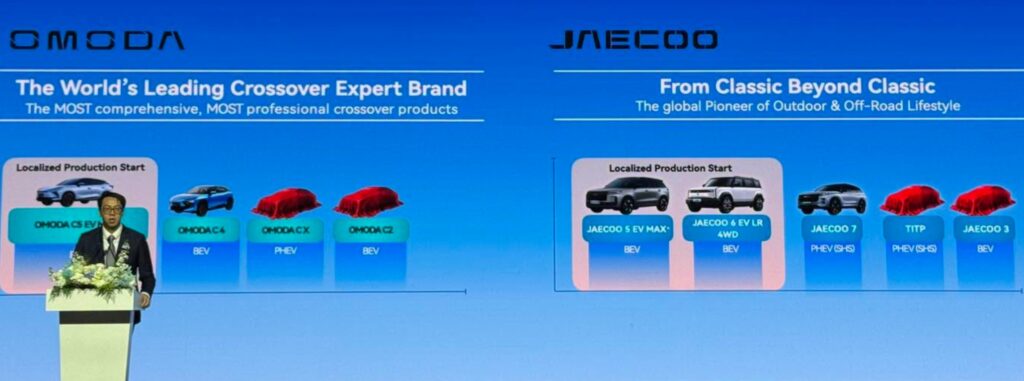
The confirmed lineup includes:
- JAECOO 5 EV Max
- JAECOO 6 EV LR AWD
- OMODA C5 EV
- CHERY V23 (iCAR V23 EV)
- CHERY Q (likely global compact EV platform)
- LEPAS L6
- LEPAS L4
This model mix confirms a broad, multi-brand strategy, covering several SUV sub-segments and price bands. Notably:
- JAECOO 6 EV LR AWD introduces a more premium, dual-motor offering with lifestyle/off-road positioning
- OMODA C5 EV remains the core volume model targeting urban mainstream buyers
- CHERY V23 adds a youth-oriented, design-led product
- LEPAS models (L4, L6) represent a new brand layer, likely targeting value-oriented segments
From a portfolio perspective, this is not a cautious rollout—it is a full-scale market entry with immediate segment coverage.
From Market Entry to Localization
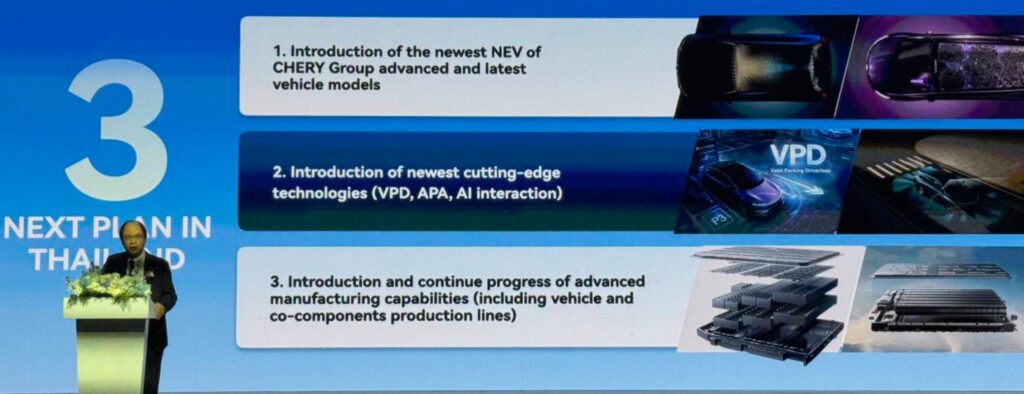
Chery’s Thailand strategy follows a structured progression: initial market entry via imports, followed by dealer network expansion, and now localization. The shift to local assembly enables cost optimization, tariff reduction, and eligibility for EV incentives.
Over a five-year horizon (2026–2030), the company has set a production target of 80,000 units annually, indicating strong confidence in both domestic demand and export potential.
In addition, the Rayong facility is expected to expand beyond vehicle assembly, with plans to incorporate battery production and key component manufacturing—a critical step toward deeper localization.
Competitive Context: A Rapidly Intensifying Landscape
Chery’s investment comes amid a broader wave of Chinese OEM localization in Thailand. The result is a sharp increase in electrified vehicle offerings, particularly in the B- and C-SUV segments.
With multiple OEMs localizing production simultaneously, pricing pressure is expected to intensify—especially in the sub-THB 1 million range, where volume competition is most aggressive.
What differentiates Chery is the simultaneous deployment of multiple brands, allowing it to target different customer profiles without excessive internal overlap.
Implications for the Thai Market
From a registration data perspective, several trends are likely to accelerate:
- Rising EV penetration, supported by increased model availability and localized pricing
- Shift in brand mix, with Chinese OEMs expanding their share of passenger vehicle registrations
- Segment concentration, particularly in compact SUV categories
- Price compression, driven by local production and intensified competition
While Japanese OEMs remain dominant in overall volume—particularly in pickup segments—the competitive gap in passenger EV categories is narrowing at a faster pace.
Supply Chain and Industrial Impact
Chery’s long-term plan to incorporate battery and key component production signals a deeper commitment to Thailand’s industrial base.
This has two important implications:
- Acceleration of EV supply chain development, particularly in high-value components
- Increased pressure on local suppliers to adapt to electrification requirements
In the near term, localization of advanced components will remain limited. However, the direction is clear: Thailand’s supplier ecosystem will need to evolve alongside OEM electrification strategies.
Outlook
Chery’s Rayong plant should be viewed not as an isolated investment, but as part of a broader structural shift in Thailand’s automotive industry.
With a multi-brand strategy, aggressive model rollout, and plans for deeper localization, Chery is positioning itself as a serious long-term player in the region.
For industry stakeholders, the implications are straightforward:
competition is intensifying, model cycles are accelerating, and pricing dynamics are becoming increasingly aggressive.
In this environment, timely and granular registration data will remain critical for tracking market developments, identifying share shifts, and supporting strategic decision-making.
Chery Thailand Production & Model Positioning Overview
Chery’s Thailand production strategy is structured by brand, with each brand targeting distinct customer segments and use cases, as reflected below.
| Brand | Model | Segment | Powertrain | Production Status | Positioning |
|---|---|---|---|---|---|
| OMODA | C5 EV | C-SUV | BEV | Initial localization | Core volume urban EV |
| OMODA | C4 | B/C-SUV | BEV | Pipeline | Secondary volume model |
| OMODA | C2 | B-SUV | BEV | Pipeline | Entry-level EV |
| OMODA | C7 | C/D-SUV | PHEV | Pipeline | Premium hybrid SUV |
| OMODA | X (PHEV) | C-SUV | PHEV | Pipeline | Performance-oriented hybrid |
| JAECOO | 5 EV Max | B/C-SUV | BEV | Localized production | Core volume SUV |
| JAECOO | 6 EV LR AWD | C-SUV | BEV (AWD) | Initial localization | Off-road lifestyle EV |
| JAECOO | 7 | C-SUV | PHEV (SHS) | Pipeline | Hybrid SUV for wider usage |
| JAECOO | 3 | B-SUV | BEV | Pipeline | Entry-level SUV |
| JAECOO | T1TP | — | PHEV | Pipeline | Future hybrid expansion |
| CHERY / iCAR | V23 (iCAR V23) | B/C-SUV | BEV | Confirmed | Youth / lifestyle EV |
| CHERY / iCAR | QQ EV | A/B segment | BEV | Confirmed | Entry-level mass EV |
| CHERY / iCAR | Tiggo 8 | D-SUV | PHEV | Pipeline | Family SUV, hybrid alternative |
| CHERY / iCAR | T1TP | — | PHEV | Pipeline | Future hybrid platform |
| LEPAS | L6 | C-SUV | BEV | Confirmed | Mid-range EV |
| LEPAS | L4 | B-SUV | BEV | Confirmed | Entry-level EV |
| LEPAS | L8 | D-SUV | PHEV | Pipeline | Premium hybrid SUV |
Key Takeaways
- Full NEV strategy (beyond BEV-only)
While BEVs dominate the lineup, Chery is clearly integrating PHEVs (OMODA C7, JAECOO 7, Tiggo 8), indicating a more balanced electrification approach. - Multi-brand segmentation executed aggressively
OMODA (urban), JAECOO (lifestyle/off-road), CHERY (core family), and LEPAS (value/premium bridge) create a layered market coverage strategy. - Deep segment coverage—from A-segment to D-SUV
The inclusion of models such as QQ EV and Tiggo 8 PHEV shows coverage from entry-level urban EVs to full-size family SUVs. - Export-ready platform strategy
Many models are based on global platforms, reinforcing Thailand’s role as a regional and potentially global export hub.
Based on Proliance registration data, shifts in segment share and OEM positioning are expected to become increasingly visible over the next 12–24 months.