Thailand’s powertrain landscape crossed a definitive threshold in Q1 2026, with electric vehicles (EV) recording 57,108 registrations, a 120.5% year-on-year increase from 25,896 units in Q1 2025 and the highest quarterly EV volume in the country’s registration history. Combined with HEV’s organic growth of 29.8% to 47,505 units, electrified powertrains now account for 52.0% of total light vehicle registrations: a majority share that signals a market in structural transition rather than cyclical fluctuation. For OEMs, distributors, and fleet operators with exposure to Thailand, the central question is no longer whether electrification is happening; it is how quickly ICE-dependent portfolios can adapt before the window for repositioning narrows.
Executive Summary
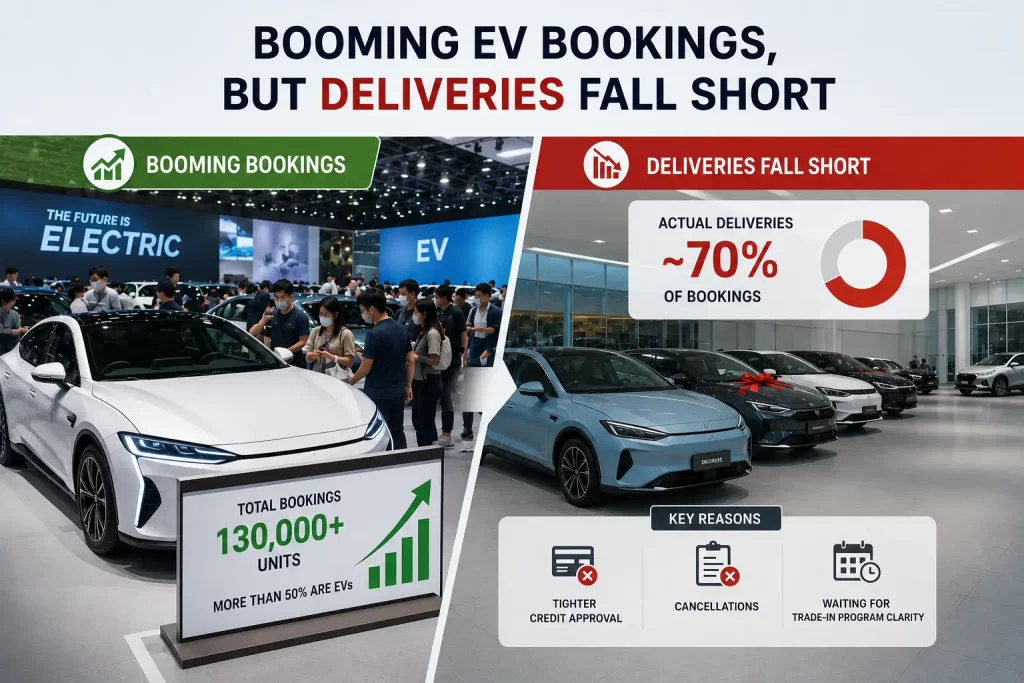
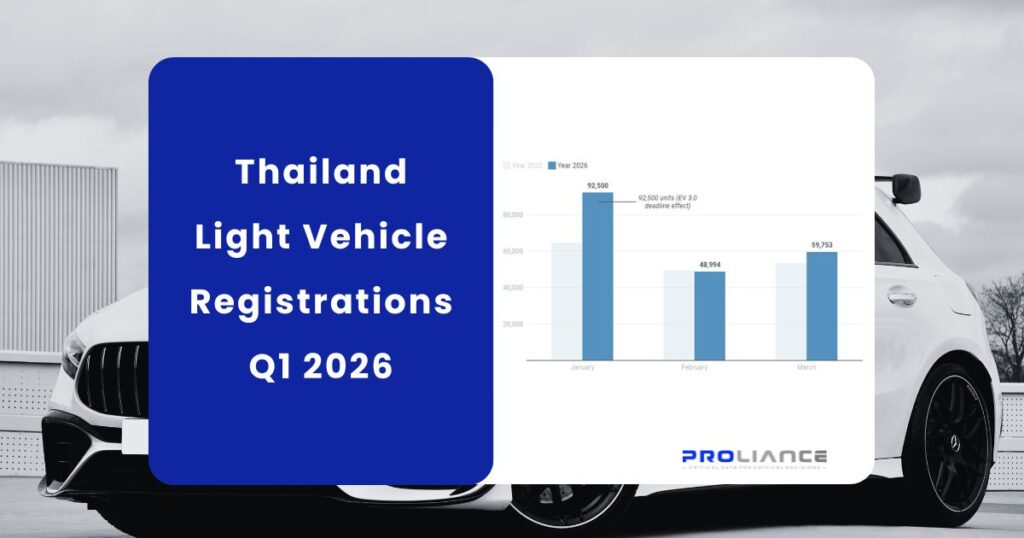
- EV registrations reached 57,108 units in Q1 2026 (+120.5% YoY), the largest single-quarter EV volume on record, materially accelerated by EV 3.0 subsidy deadline deliveries concentrated in January 2026.
- HEV grew organically to 47,505 units (+29.8% YoY), outpacing policy-sensitive EV on a structural basis and representing the more durable demand signal for Q2 planning.
- EV and HEV combined reached 52.0% of total market share, up from approximately 37.5% in Q1 2025 and below 33% in Q1 2024, a trajectory that has consistently outpaced Thailand's official 30% EV adoption target timeline.
- Diesel declined to 30.3% share (-3.6% YoY) and Petrol contracted 16.4% YoY to 15.2% share, confirming that ICE powertrain erosion is broad-based across all conventional fuel categories.
- REEV entered the market at 447 units in Q1 2026, establishing a new powertrain category that warrants tracking as a potential bridge segment between PHEV and full BEV adoption.
Three-Year Powertrain Trend: Q1 2024 to Q1 2026
The Q1 2026 figures do not represent an isolated event. A three-year registration series confirms that Thailand’s powertrain transition has been compounding consistently since 2024, with EV volume nearly doubling from Q1 2024 to Q1 2025 before surging again in Q1 2026 under the combined effect of EV 3.0 incentives and accelerated delivery timelines
Fuel Type Registration Data: Q1 2024 to Q1 2026
EV and Electrified Powertrains
EV has been the fastest-growing fuel category across all three periods. From 23,722 units in Q1 2024, registrations grew to 25,896 units in Q1 2025 before accelerating sharply to 57,108 units in Q1 2026. The two-year cumulative growth rate of 140.7% reflects both structural demand and significant policy amplification. The EV 3.0 subsidy framework offered import duty and excise tax reductions for qualifying models, creating a delivery concentration in January 2026 where a disproportionate share of Q1 EV volume was recorded. OEMs and analysts should treat Q1 2026 EV volume as a policy-event figure rather than a clean organic demand baseline.
HEV tells a structurally different and arguably more important story for medium-term planning. Growing from a combined Hybrid base of 39,168 units in Q1 2024 to 36,593 units in Q1 2025 (disaggregated HEV-only basis) before reaching 47,505 units in Q1 2026, HEV demand has expanded without material subsidy support. This organic trajectory reflects genuine consumer preference for electrified powertrains that do not require charging infrastructure dependency, a critical factor in Thailand’s provincial markets where public charging coverage remains uneven.
Conventional Powertrains
Diesel remains the single largest fuel type by volume at 60,984 units (30.3% share), but its trajectory is unambiguously downward. From 79,272 units in Q1 2024 to 63,258 units in Q1 2025 and 60,984 units in Q1 2026, Diesel has shed nearly 23.1% of its Q1 2024 volume in two years. The primary driver is LCV contraction: Diesel’s stronghold in the pickup and commercial vehicle segment has been compressed by tightened hire-purchase credit standards and softening SME demand.
Petrol has experienced the sharpest proportional decline among conventional powertrains, falling from 50,596 units in Q1 2024 to 36,503 units in Q1 2025 and 30,535 units in Q1 2026, a 39.6% cumulative decline over two years. Volatile fuel prices and the growing accessibility of HEV models at competitive price points have accelerated the migration away from Petrol, particularly in the passenger car segment where consumer sensitivity to running costs is highest.
| Fuel Type | Q1 2024 | Q1 2025 | Q1 2026 | 2-Year Change |
|---|---|---|---|---|
| Diesel | 79,272 | 63,258 | 60,984 | -23.1% |
| EV | 23,722 | 25,896 | 57,108 | +140.7% |
| Hybrid / HEV * | 39,168 | 36,593 | 47,505 | +21.3% |
| Petrol | 50,596 | 36,503 | 30,535 | -39.6% |
| PHEV | — | 4,107 | 3,721 | — |
| MHEV | — | 859 | 846 | — |
| REEV | — | — | 447 | New entry |
Q1 2024 figure represents combined Hybrid category (HEV, PHEV, MHEV not separately reported). Q1 2025 and Q1 2026 reflect HEV only.
Policy Context: EV 3.0 and the Subsidy Cliff
The EV 3.0 policy framework, introduced by the Thai government to position Thailand as a regional EV manufacturing and adoption hub, provided import duty exemptions and excise tax reductions for qualifying battery electric vehicles. The program required manufacturers to commit to local production volumes in exchange for the incentive structure, creating a delivery timeline dynamic where importers and distributors accelerated vehicle delivery into Q1 2026 to capture subsidy eligibility before the policy window closed.
The result is visible in January 2026’s disproportionately high registration volume, which accounted for 46% of Q1 2026 total registrations. This delivery concentration means that Q2 2026 EV figures are highly likely to normalize materially before recovering as the EV 3.5 framework and market-driven demand establish a new baseline. Tightened hire-purchase credit standards introduced by the Bank of Thailand from late 2025 add a further constraint on mass-market EV adoption for buyers reliant on non-bank financing. For OEMs managing Thailand inventory allocation, Q1 2026 EV volume should not serve as the basis for Q2 or Q3 planning without adjusting for the EV 3.0 delivery pull-forward effect.
HEV as the Structural Signal
While EV captures headline attention, HEV’s 29.8% YoY growth to 47,505 units is the more strategically significant data point for medium-term market planning. HEV demand in Thailand is not policy-dependent in the same way as BEV: there are no equivalent subsidy frameworks, no charging infrastructure requirements, and no delivery concentration dynamics. Growth is driven by product availability, consumer preference for fuel efficiency, and the expanding model range offered by Japanese OEMs with established hybrid portfolios.
The HEV trajectory also has implications for the competitive dynamics between Japanese and Chinese OEMs. Chinese brands have entered Thailand almost exclusively through BEV models, leaving the HEV segment largely to Toyota, Honda, and other Japanese manufacturers. If HEV continues to grow organically while BEV demand normalizes post-EV 3.0, Japanese OEMs retain a structural advantage in the electrified segment that does not depend on subsidy cycles.
REEV: A New Category to Watch
The appearance of 447 REEV (Range-Extended EV) units in Q1 2026 marks the emergence of a new powertrain category in Thailand’s registration data. REEV combines a battery electric drivetrain with a small internal combustion engine acting as a generator, offering EV-like efficiency in urban use with reduced range anxiety for provincial or long-distance driving. At 0.2% market share, REEV is not yet a volume story. However, its entry coincides with growing consumer awareness of charging infrastructure limitations outside Bangkok and major urban centers, suggesting a potential demand niche that could build meaningfully in H2 2026 and beyond. OEMs and distributors with REEV models in their global portfolios should monitor Q2 and Q3 2026 registration data for early adoption signals before committing to network or inventory investment.
Analyst Note
The 52.0% combined EV and HEV share in Q1 2026 is a structurally significant milestone, but it requires careful decomposition before informing strategic decisions. EV’s 120.5% YoY growth is real in volume terms but partially artificial in timing: the EV 3.0 delivery concentration inflates Q1 2026 figures relative to underlying demand. HEV’s 29.8% growth reflects genuine market preference and is a more reliable input for Q2 to Q3 planning. Diesel’s continued decline is structural and unlikely to reverse: the combination of LCV contraction, credit tightening, and HEV substitution in the passenger car segment creates a multi-vector headwind that no single policy intervention is likely to offset. For OEMs without a credible HEV offering in Thailand’s B and C segment price bands, the competitive window is narrowing faster than the headline EV numbers suggest.
Strategic Implications
| Audience | Key Implication | Priority Action |
|---|---|---|
| OEMs (Japanese) |
HEV organic growth at 29.8% YoY plays directly to established hybrid portfolios; BEV competition from Chinese brands remains subsidy-dependent | Prioritize HEV model expansion and dealer network training before Q3 2026; do not over-index on BEV response until post-EV 3.0 demand baseline is confirmed |
| OEMs (Chinese) |
BEV volume in Q1 2026 is partially inflated by EV 3.0 deadline effect; HEV segment remains structurally uncontested by Chinese brands | Assess whether Q2 2026 BEV demand sustains without subsidy support; evaluate HEV product roadmap for Thailand market entry |
| Distributors | EV 3.0 subsidy closure creates inventory normalization risk; REEV entry signals a potential new segment requiring separate network and service capability | Align Q2 to Q3 inventory orders to normalized monthly demand of 50,000 to 60,000 total units; begin REEV feasibility assessment |
| Fleet Operators | HEV total cost of ownership advantage over Diesel is strengthening as fuel price volatility persists; BEV fleet suitability depends on route and charging infrastructure coverage | Conduct HEV vs. Diesel TCO analysis for 2026 to 2027 fleet renewal cycles; map BEV suitability against operational routes before committing |
| Market Analysts | Q1 2026 EV volume is not a clean organic demand figure; YoY comparisons through Q2 2026 require EV 3.0 base-effect adjustment | Use Proliance's monthly province-level database to isolate January delivery concentration and model normalized Q2 demand trajectory |
Outlook
Thailand’s powertrain transition will enter a critical test phase in Q2 and Q3 2026. With EV 3.0 incentives closed and no confirmed replacement framework yet operational, BEV demand will need to demonstrate organic sustainability for the first time at scale. The EV 3.5 policy framework, expected to require higher levels of local content than EV 3.0, will shape which brands and models qualify for the next incentive cycle and may accelerate the shift toward locally assembled EV models over imported units. HEV is positioned as the near-term volume anchor for electrified powertrains regardless of BEV policy outcomes. Proliance will publish Q2 2026 fuel type registration data by province as figures are confirmed, providing the granularity required to separate structural demand from policy-event effects.
For the broader Q1 2026 market context including brand rankings, segment breakdown, and total registration volume, see: Thailand Light Vehicle Registrations Q1 2026
Access the Full Dataset
This analysis is based on Proliance’s vehicle registration database covering Thailand at province level, with fuel type disaggregation from Q1 2024 onward. To request a data sample or discuss coverage for your market intelligence needs:
Proliance Company Limited — Critical Data for Critical Decisions
References
- Bank of Thailand, State of Thai Economy Monthly Report, January 2026. bot.or.th
- Thailand Board of Investment, Thailand Updates EV3 / EV3.5 Incentives to Strengthen Position as Regional EV Hub. thailand.go.th
- The Nation Thailand, EV Delivery Surge and Automotive Industry Coverage, Q1 2026. nationthailand.com
- Netsol Technologies, Decoding the BOT Mandate: Thailand Hire-Purchase and Leasing Credit Standards. netsoltech.com