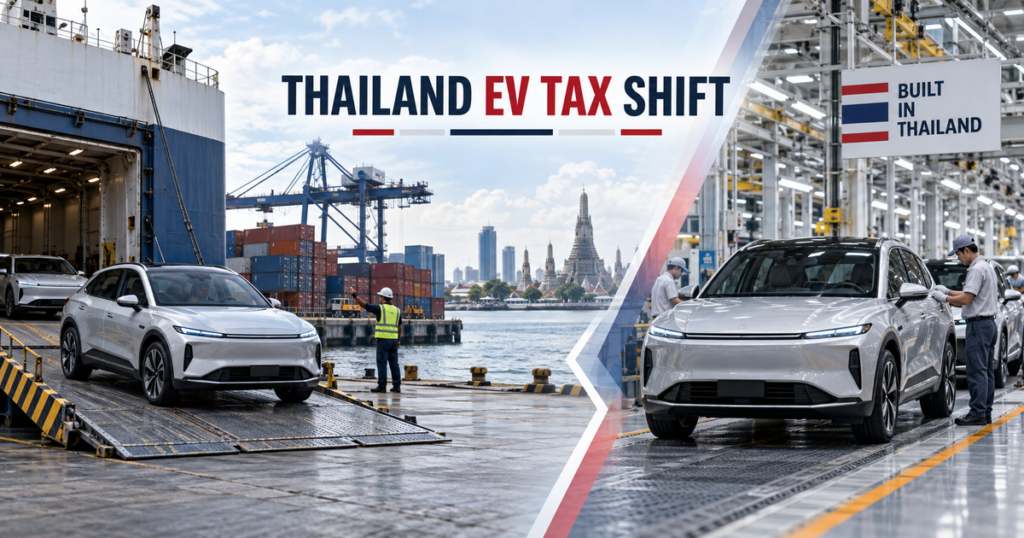
Thailand’s Cabinet has approved a sharp increase in excise tax on certain fully imported electric vehicles, strengthening the incentive for manufacturers to invest in domestic production. The decision will reshape the competitive environment for Chinese EV brands, with different implications for companies manufacturing in Thailand and those relying on imports.
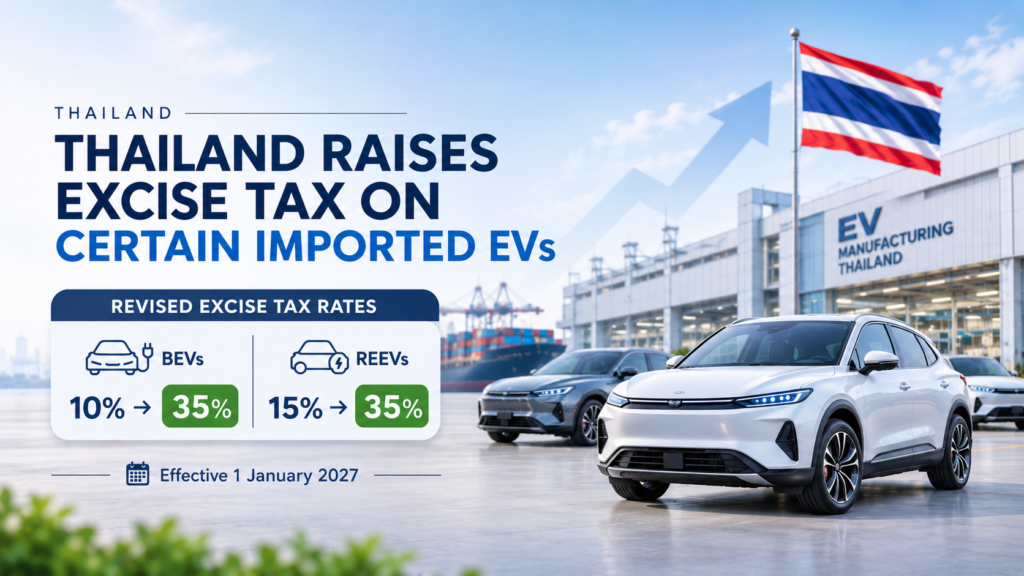
Approved on 3 November 2026, the revised rates are scheduled to take effect on 1 January 2027. For affected battery electric vehicles (BEVs), excise tax will rise from 10% to 35%. For affected range-extended electric vehicles (REEVs), the rate will increase from 15% to 35%.
Understanding the tax change
The measure concerns excise tax, which is separate from customs import duty. It also applies according to the relevant vehicle and investment conditions, rather than specifically targeting Chinese brands.
| Affected vehicle category | Existing excise rate | Approved rate from January 2027 |
|---|---|---|
| Imported BEVs | 10% | 35% |
| Imported REEVs | 15% | 35% |
These rates describe the affected import categories, rather than the tax treatment of every EV sold in Thailand. The government has presented the restructuring as a means of encouraging domestic manufacturing, supporting local component suppliers and sustaining employment.
For Chinese automakers, the distinction is significant. Manufacturers with Thai production operations face a different commercial position from businesses supplying the market entirely through imported finished vehicles.
Protecting investment and strengthening local production
The government’s stated objective is to reinforce Thailand’s role as an automotive manufacturing and export base. Its earlier EV Board framework linked preferential tax treatment to investment, production and the economic value created within the country.
The investment backdrop is substantial. Reuters, citing the Board of Investment, reported that cumulative investment approvals across Thailand’s EV ecosystem reached US$4.59 billion across 189 projects by August 2026. These figures represent approvals, rather than confirmation that all investment has been deployed.
Reuters also reported that industry groups had warned in May about mounting pressure on domestic manufacturers from lower-cost Chinese imports. The restructuring therefore addresses an industrial concern alongside the government’s ambition to expand electric mobility.
In Proliance’s assessment, the policy raises the commercial importance of establishing a sustainable manufacturing presence in Thailand. However, its success will depend on whether investment commitments translate into operating factories, meaningful local sourcing and sustained production.
Different implications for Chinese brands
Chinese manufacturers should not be viewed as a single group when assessing the impact.
Brands already producing in Thailand may gain a stronger competitive position relative to import-dependent rivals. Businesses relying on fully imported vehicles could face greater pressure to adjust prices, absorb additional costs, narrow their model ranges or accelerate local assembly plans.
However, operating a Thai factory should not automatically be interpreted as securing preferential treatment for every imported model. Model eligibility, investment conditions and the final implementation arrangements will remain important.
Reporting published on 4 November indicated that preferential import-quota arrangements linked to domestic investment had yet to be finalised. Announced production plans should consequently be distinguished from confirmed eligibility for favourable tax treatment.
Implications for pricing and purchase timing
The increase from 10% to 35% represents a 25-percentage-point rise in the affected BEV excise rate. It does not translate directly into a 25% increase in showroom prices.
The retail impact will depend on the applicable tax calculation, manufacturers’ margins, inventory positions and pricing decisions. Responses are therefore likely to differ between brands and models.
Proliance sees potential for purchases and deliveries to shift ahead of implementation as distributors manage stock and buyers assess possible price changes. Any resulting increase in registrations before January should be examined alongside subsequent months before being interpreted as sustained demand growth.
Reading the registration market correctly
The policy arrives during a broader shift in Thailand’s powertrain mix. Reuters reported that electric vehicles, conventional hybrids and plug-in hybrids together represented 55% of new-car registrations in January–July 2026, citing the Board of Investment. This combined share should not be interpreted as BEV market share.
Understanding the tax change’s effects will require more than tracking total EV registrations. Analysis should examine performance by brand, model and powertrain and, where reliable production-origin information is available, distinguish imported vehicles from those manufactured locally.
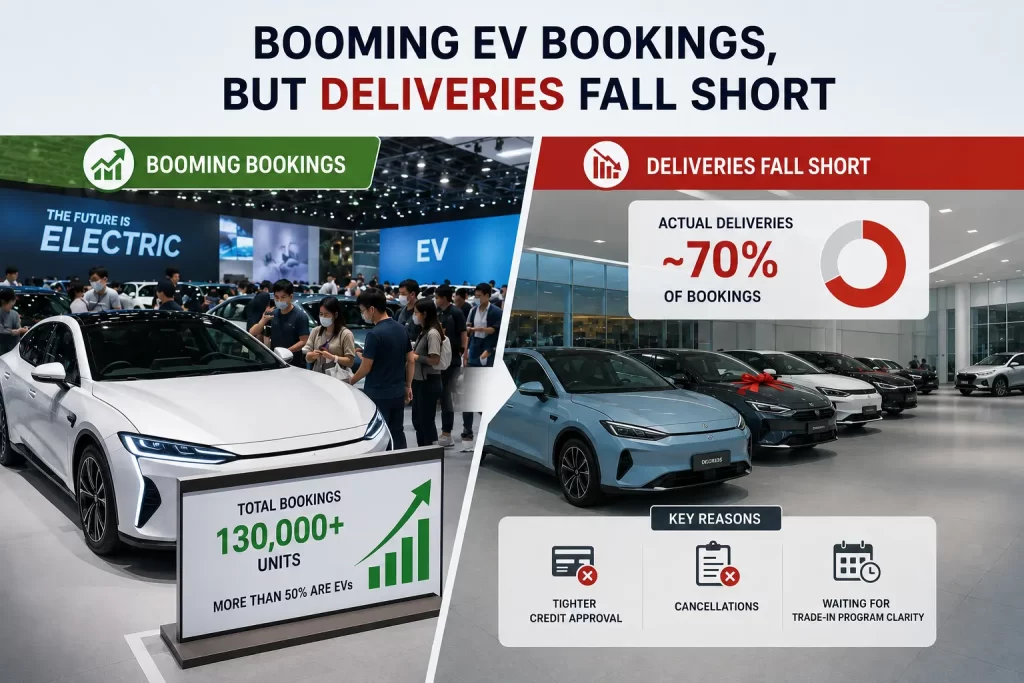
Registrations also measure a different stage of activity from bookings, customs clearances and factory output. Movements in these indicators may occur at different times, particularly around a policy transition.
What comes next
Proliance’s assessment is that the restructuring will make production location and incentive eligibility increasingly important to competitive positioning in Thailand’s EV market.
Chinese manufacturers will face different outcomes according to their manufacturing footprint, model strategy and ability to operate under the revised framework. For Thai suppliers, opportunities will depend on the extent to which manufacturers develop domestic sourcing alongside vehicle assembly.
The longer-term test will be whether the higher tax encourages sustained local investment and supplier participation while preserving a competitive market for consumers.
Sources: Ministry of Finance, press release No. 115/2569, 3 November 2026; Royal Thai Government, EV Board policy announcement, 10 September 2026; Reuters, 3 November 2026; The Nation, 4 November 2026.
Policy information checked as of 5 November 2026. Forward-looking market implications represent Proliance’s analysis.