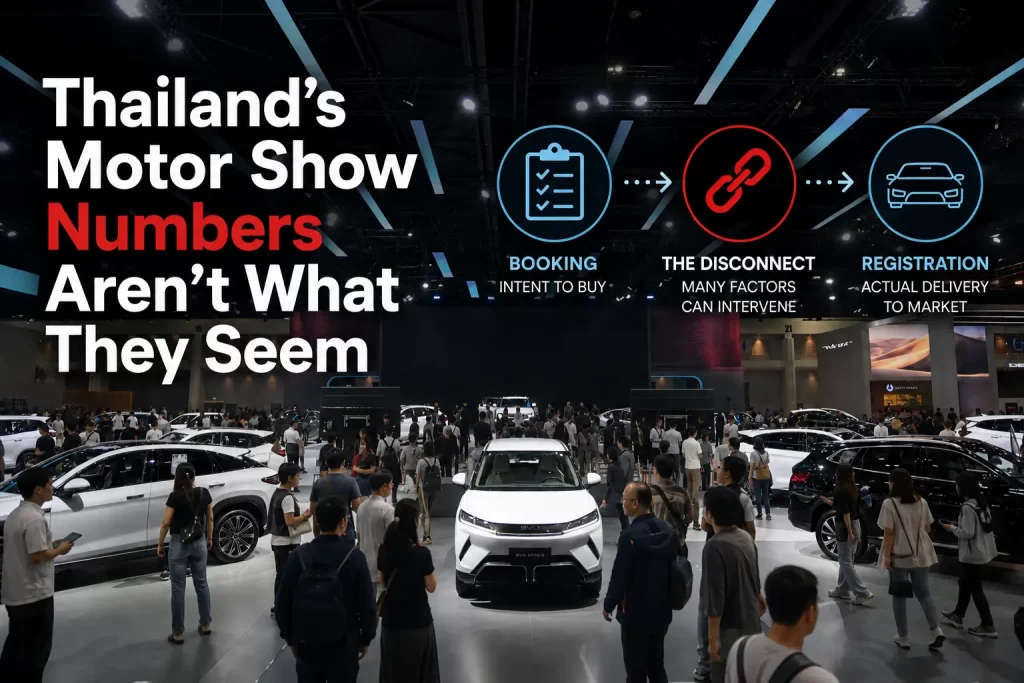
Thailand’s 47th Bangkok International Motor Show closed with record bookings of 132,951 units, the highest in the event’s history. However, SCB EIC projects that only around 70% will convert into actual deliveries. For OEM headquarters and dealer network strategists, this gap between booking euphoria and registration reality is the single most important planning signal of 2026.
Market Overview
The 47th Motor Show (March 25 to April 5, 2026) set a new booking record, supported by strong electric vehicle demand and the growing presence of Chinese automakers. Yet the conversion rate from booking to registration has weakened relative to historical norms.
| Motor Show Metrics | Current (2026) | Historical / Comparison |
|---|---|---|
| Total Car Bookings | 132,951 units | 77,379 units (in 2025) |
| Booking Growth (YoY) | +71.8% | - |
| Delivery Rate | ~70% (Projected) | 75% to 80% (2022-2025 Avg.) |
| Top Brand | BYD (17,354 units) | BYD / DENZA (10,353 units in 2025) |
Booking Records Mask a Weakening Conversion Rate
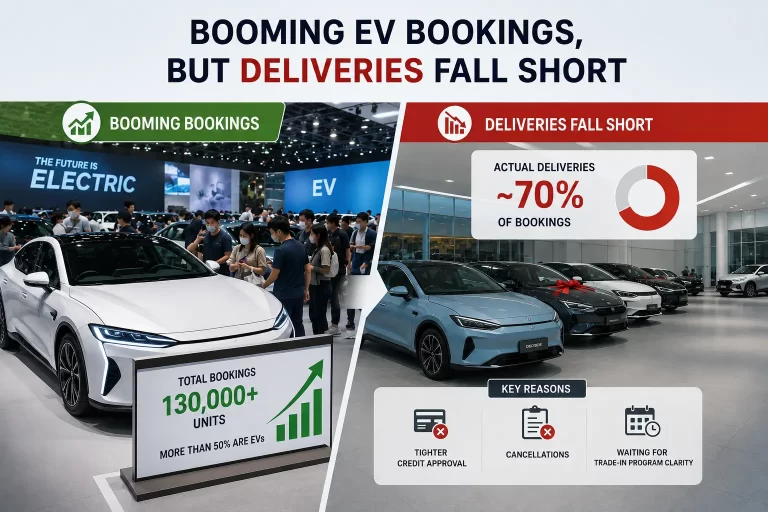
The 132,951-unit booking total represents a 71.8% increase over the 2025 Motor Show (77,379 units), a steep acceleration in headline demand. However, SCB EIC estimates the actual delivery rate will settle at around 70% of bookings, down from a 75% to 80% average across 2022 to 2025. The drivers are threefold: (1) still-tight credit approval conditions, particularly for EVs that require high down payments and shorter loan tenors; (2) order cancellations as buyers respond to newer model launches or extended delivery timelines; and (3) buyer hesitation pending clarity on the government’s trade-in scheme. For OEMs, the implication is direct: headline booking figures increasingly overstate registration outcomes, and production or import scheduling calibrated to bookings alone carries material downside risk.
Chinese Brands Lead the Booking Table
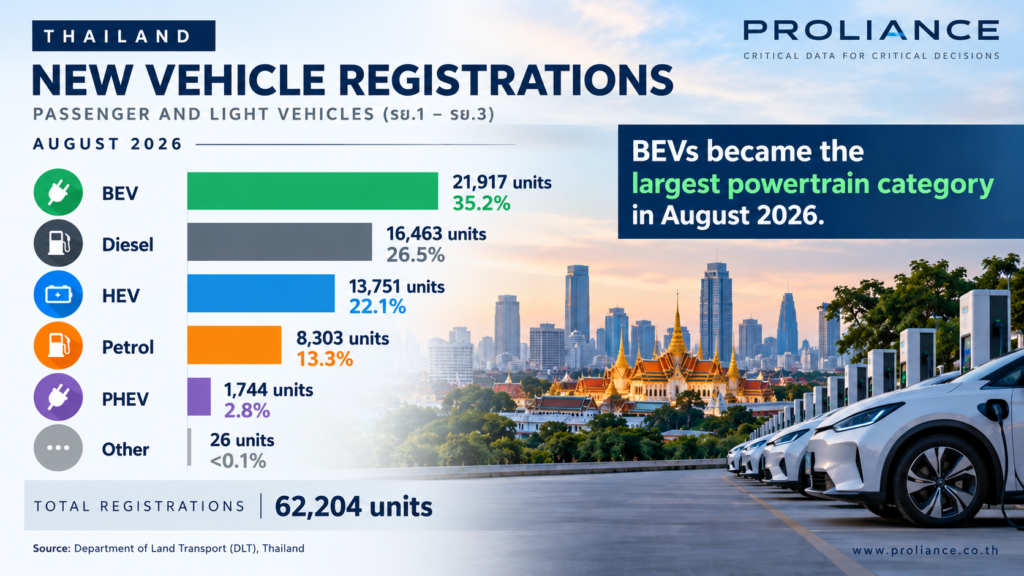
Booking composition at the 47th Motor Show confirms the structural shift in Thailand’s competitive landscape. BYD led all brands with 17,354 units, ahead of Toyota at 15,750 units and Omoda Jaecoo at 15,088 units. The presence of two Chinese marques in the top three, combined with rising interest in recently entered automakers, signals that Thai consumer preference is shifting toward value and technology rather than traditional brand loyalty. This is consistent with Proliance registration data: in Q1 2026, EV and HEV powertrains combined reached 52.0% of total light vehicle registrations, up from approximately 37.5% in Q1 2025.
Limited Economic Pass-Through and Supply Chain Strain
SCB EIC notes that the positive impact on the Thai economy is likely to remain limited, as current market momentum is increasingly driven by imported vehicles rather than domestic production. This constrains value capture for the local supply chain. In parallel, the readiness of supporting infrastructure, including parts supply, charging networks, and EV-capable service capacity, will need to accelerate to match registration growth and contain the long-term ownership cost of EVs.
Key Takeaways
- Discount the headline number: With SCB EIC projecting a 70% conversion rate, OEMs should treat the 132,951-unit booking figure as roughly 93,000 likely registrations when calibrating supply plans.
- Conversion risk is now structural: The decline from a 75% to 80% historical delivery rate reflects persistent credit tightening, not a one-off event; financing accessibility is now a core volume variable.
- Chinese OEMs have shifted the competitive baseline: BYD leading the booking table ahead of Toyota confirms that value and technology positioning, not brand heritage, drives the current Thai market.
- Imported-led growth limits local value capture: Strong sales do not translate proportionally into domestic economic contribution, a point of growing policy sensitivity.
- After-sales capacity is the next constraint: Parts supply, charging infrastructure, and service network depth must scale with registrations to avoid eroding ownership economics and brand equity.
Conclusion
For OEM headquarters and dealer network managers, Thailand’s 2026 Motor Show is best read not as a demand signal but as a conversion test. The brands that translate record bookings into registrations, while securing financing pathways and after-sales readiness, will define competitive position in ASEAN’s most closely watched EV market through the remainder of the year.