Understanding the Growing Disconnect Between Booking Numbers and Actual Vehicle Registrations in Thailand
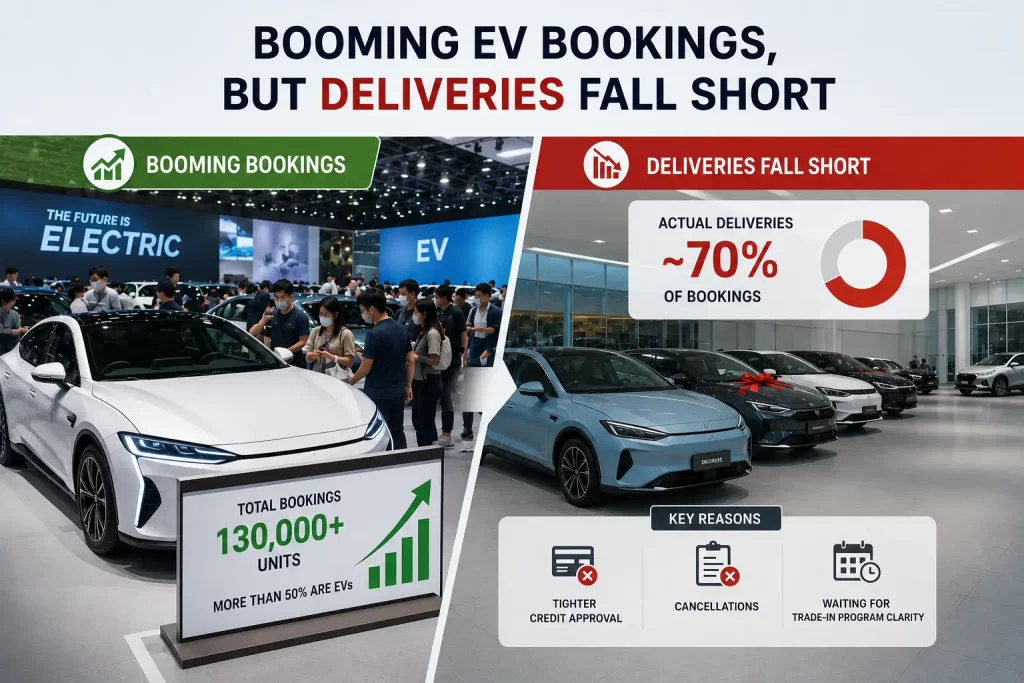
Every major motor show in Thailand generates headline booking totals that signal strong consumer demand. In practice, many of these figures represent reservations rather than completed retail transactions: financing approval, production allocation, and confirmed delivery dates remain unresolved at the time of booking. As the EV segment expands and new market entrants accelerate their promotional campaigns, the gap between reported booking volume and verified registration data has become a planning variable that directly affects allocation decisions, network investment, and market share reporting accuracy.
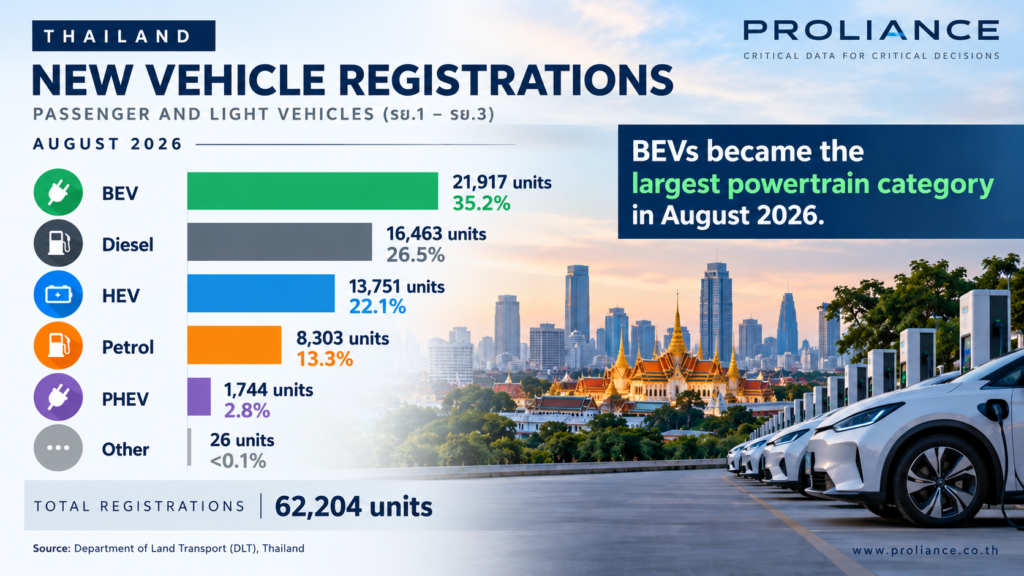
At Proliance, registration data remains our baseline for market activity measurement precisely because it reflects vehicles that have physically entered operation within the market.
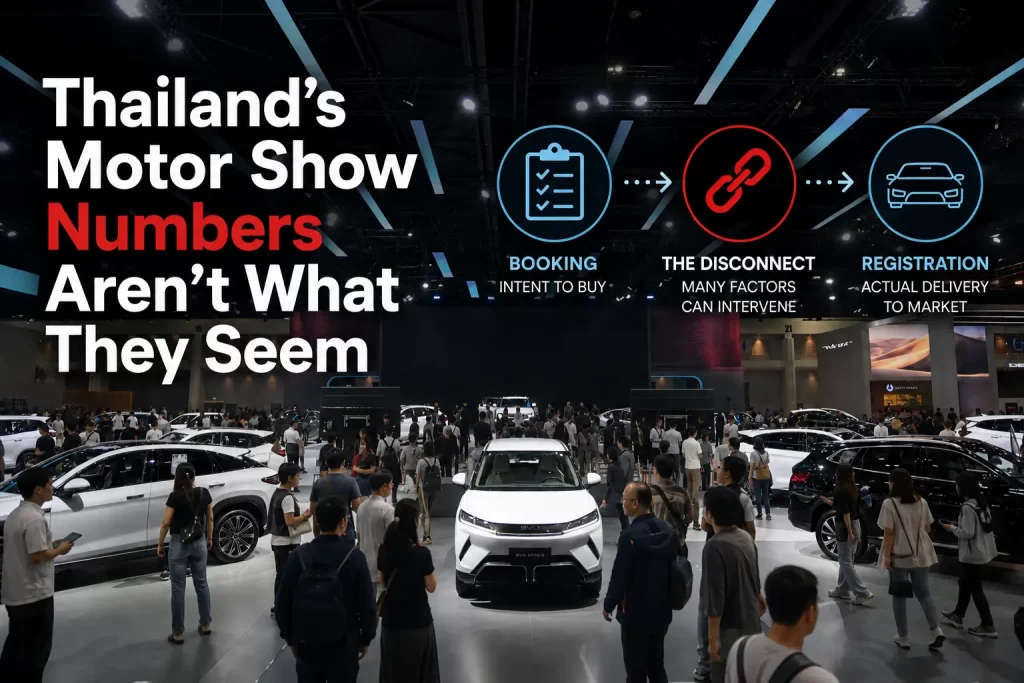
Bookings Reflect Intent: Registrations Reflect Reality
Motor show bookings represent consumer intent at a specific point in time, shaped by marketing campaigns, financing promotions, and showroom momentum. At the time of reservation, critical variables including financing approval, production allocation, inventory availability, and confirmed delivery dates remain unresolved.
Vehicle registration data, by contrast, reflects units that have completed the full retail pipeline: the vehicle physically exists in the market, ownership documentation is finalized, financing is secured, and the unit has entered the national vehicle parc.
In short: booking data captures intent. Registration data captures reality.
The gap between the two has widened considerably in recent years.
The Rise of “Selective Visibility” in Automotive Reporting
Historically, Thailand’s automotive market relied on wholesale shipment reporting and manufacturer sales announcements to assess market performance. That baseline has shifted. The rapid emergence of BEVs, new Chinese automotive brands, online reservation systems, and direct-to-consumer sales models has created a more volatile and less predictable retail landscape.
Compounding this, some manufacturers have reduced publicly shared sales visibility in recent years, making independent registration-based analysis increasingly important for understanding actual market conditions. Registration datasets provide independently verifiable market activity, confirmed vehicle parc expansion, and clearer insight into realized demand rather than promotional momentum.
For OEMs, suppliers, financial institutions, and aftermarket participants, this distinction has direct implications for planning accuracy.
The Impact of EV Competition on Booking Behavior
The competitive dynamics within Thailand’s EV segment differ materially from the traditional Japanese-led market that dominated for decades. Toyota, Honda, and Isuzu built their distribution ecosystems around disciplined allocation planning, predictable production schedules, and conservative inventory management. Booking-to-registration conversion under this model was relatively stable and predictable.
Newer EV entrants operate under different commercial logic. Many are prioritizing rapid market share expansion through aggressive booking campaigns, accelerated dealership growth, and highly competitive pricing, often at a pace that outstrips their confirmed near-term delivery capability. The result is a structural condition where booking activity grows significantly faster than operational delivery output.
This dynamic is the primary driver behind what the market increasingly refers to as “overbooking”: reservations accepted before VIN assignment, confirmed inventory arrival, or finalized production allocation are in place.
Why Overbooking Situations Occur
Dealerships continue accepting reservations despite uncertain allocation visibility, fluid production schedules, limited import capacity, and incomplete inventory confirmation. Two commercial incentives drive this behavior.
First, booking volume serves as a key performance metric during motor shows. Strong booking numbers generate media attention, strengthen brand perception, and create the appearance of robust market demand, regardless of whether confirmed delivery capacity exists to support them.
Second, dealers are often reluctant to acknowledge uncertain delivery timing during competitive promotional periods. As a result, reservations are frequently accepted before VIN assignment, confirmed inventory arrival, or finalized production allocation.
This does not necessarily indicate malicious intent. Dealers themselves are often operating within rapidly changing allocation environments. The outcome, however, remains the same: a structural mismatch between headline booking figures and eventual registrations.
Booking Cancellation Rates: A Structural Risk for Market Forecasting
Motor show reservations carry inherently higher cancellation risk than finalized retail transactions. Low booking deposits, flexible cancellation conditions, and event-driven purchasing decisions create a fragile conversion pipeline. Bookings can collapse at multiple stages: financing rejection, prolonged delivery delays, competing promotional offers, sudden price adjustments, or the introduction of newer model variants before delivery occurs.
This risk is most acute in the EV segment, where pricing remains highly dynamic, competitive incentives shift rapidly, and consumers are increasingly sensitive to technology cycle changes. Under these conditions, headline booking totals announced immediately after motor shows do not reliably predict registration volume in subsequent months.
Why Registration Data Provides a More Reliable Planning Baseline
Registration data filters out the volatility inherent in booking-based reporting: speculative reservations, duplicate bookings, cancellations, and promotional event momentum do not appear in registration figures. What remains is a verified record of units that have physically entered the market.
For OEMs, distributors, and dealer network managers, this makes registration data the more defensible foundation for market share analysis, production forecasting, supplier planning, dealership performance evaluation, and aftermarket demand estimation.
This reliability is particularly relevant as Thailand’s automotive sector navigates simultaneous shifts in EV adoption, consumer behavior, distribution models, and competitive pricing. During periods of rapid structural transition, registration data provides a stable measurement baseline that booking figures cannot replicate.
Pre-Registration Activity: An Additional Layer of Market Distortion
In some market segments, dealers register vehicles before final retail delivery to achieve internal sales targets, accelerate aging inventory movement, or improve short-term performance reporting. While this practice is not unique to Thailand, elevated pre-registration activity distorts market interpretation in ways that booking data alone cannot reveal.
Over time, sustained pre-registration volume contributes to used vehicle pricing pressure, inventory digestion challenges, resale value volatility, and discrepancies between reported sales momentum and underlying retail demand. Registration-based analysis can identify and track these patterns across reporting periods, providing OEMs and distributors with a clearer picture of where headline figures diverge from actual market conditions.
Looking Beyond Promotional Headlines
Motor shows remain useful indicators of consumer excitement, brand visibility, and short-term market sentiment. From a planning perspective, however, booking figures require qualification against registration-based data before they can reliably inform allocation decisions, network investment, or market share analysis.
As Thailand’s automotive market becomes increasingly competitive and structurally complex, the distinction between promotional momentum, booking activity, and actual realized registrations carries direct consequences for forecast accuracy. For organizations requiring actionable automotive intelligence, registration data provides the most defensible window into real market conditions.
At Proliance, we remain committed to delivering registration-based intelligence that supports clearer visibility into actual market activity, beyond the promotional headlines.