Thailand is preparing to increase the excise tax applied to imported electric vehicles as the government moves from encouraging rapid EV adoption toward strengthening domestic production and local supply chains.
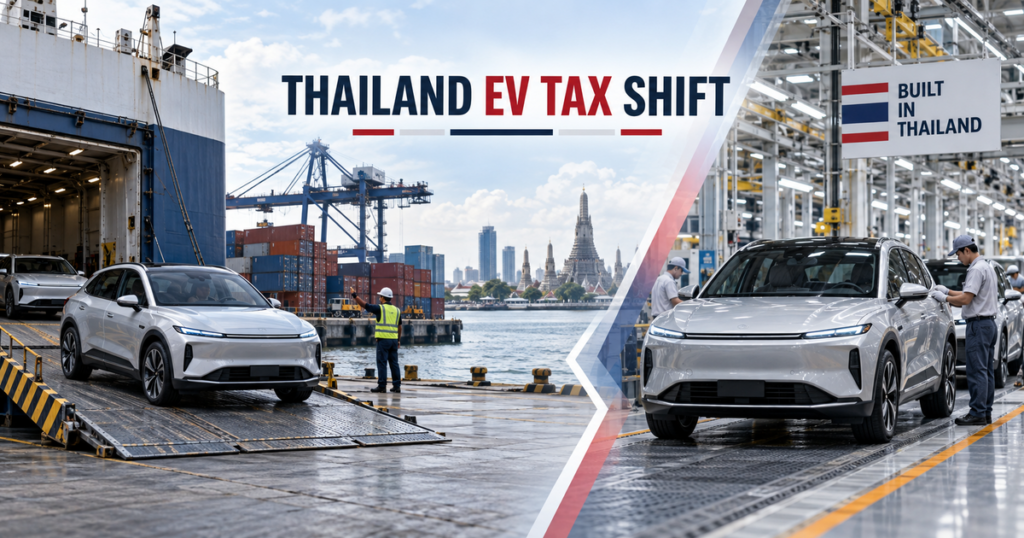
On 10 September 2026, Thailand’s National Electric Vehicle Policy Board agreed in principle to introduce a tiered excise-tax structure based on how vehicles are imported or manufactured.
Under the proposed structure:
- Completely built-up electric vehicles imported into Thailand will face the highest excise-tax rate, exceeding the current rate of 10%.
- Vehicles imported for testing or in connection with local assembly and production will receive a lower rate.
- Electric vehicles manufactured in Thailand using locally sourced content will qualify for the lowest rate.
Automakers will be given a grace period to adjust to the new structure. However, the duration of that period has not yet been determined.
The Finance Ministry expects the applicable tax rates to be finalized by the end of September 2026. As of 14 September, no detailed implementing notification, effective date or local-content qualification formula had been announced.
Excise Tax, Not Simply an Import Tariff
The proposed measure has frequently been described as an increase in the “tax on imported EVs.” It is important, however, to distinguish excise tax from customs duty.
Customs duty is imposed when a vehicle enters Thailand and can vary according to its country of origin and the relevant free-trade agreement. Excise tax is a separate domestic tax applied according to the vehicle’s prescribed classification and tax rate.
The new policy therefore appears intended to create a wider excise-tax advantage for EVs that contribute more directly to Thai manufacturing and local economic activity. It should not be interpreted simply as a uniform increase in customs tariffs on all imported electric vehicles.
The precise effect on an individual model will depend on several factors, potentially including:
- Whether it is imported as a completely built-up vehicle
- Whether local assembly is involved
- Its level of qualifying Thai content
- Existing customs privileges under applicable trade agreements
- The final excise rates and implementation date
- Eligibility under Thailand’s existing EV-support programs
Until the detailed regulations are published, the eventual retail-price effect cannot be calculated reliably.
Thailand’s EV Policy Is Entering a New Phase
Thailand’s earlier EV measures successfully encouraged automakers to introduce electric vehicles, reduce retail prices and expand the market rapidly.
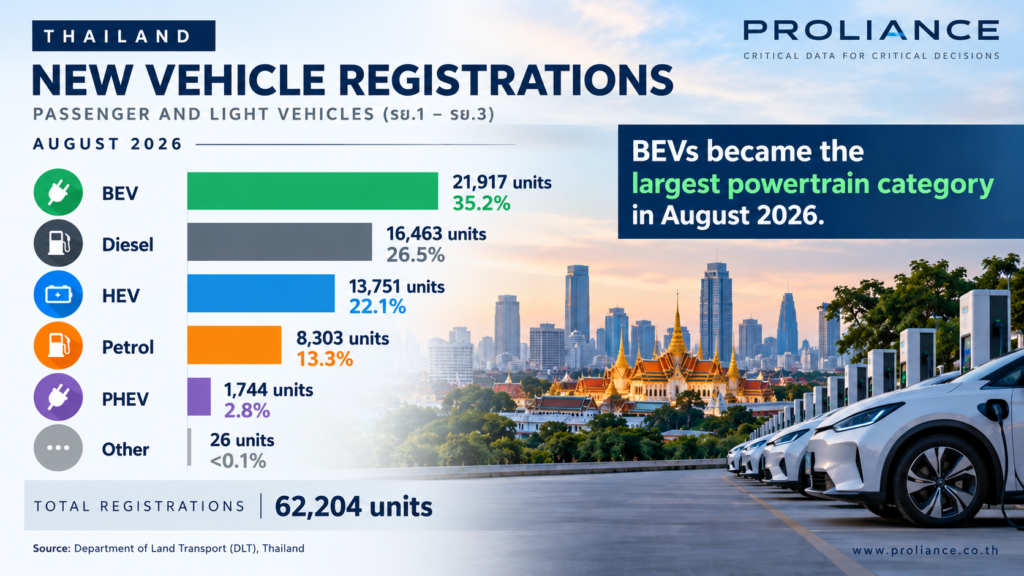
According to information released alongside the latest policy decision, battery-electric, hybrid and plug-in hybrid vehicles collectively represented 55% of new-car registrations during the first seven months of 2026. This was the first time that combined registrations of these electrified powertrains exceeded those of internal-combustion vehicles over the period.
The growing market share of electrified vehicles demonstrates that Thailand’s transition is no longer at an early-adoption stage. The policy challenge is now shifting from stimulating consumer demand to converting that demand into domestic manufacturing, investment, technology transfer and employment.
The proposed excise structure reflects this change in direction. Imported vehicles may still play an important role in providing model choice and introducing new technology, but locally manufactured vehicles will receive a clearer tax advantage.
Possible Short-Term Effect on Registrations
The announcement could affect EV registrations even before the new rates formally take effect.
Distributors holding imported inventory may seek to accelerate sales, deliveries or registrations before the higher rate begins. Promotional activity may also increase if companies want to clear existing completely built-up stock during the adjustment period.
This creates the possibility of a temporary increase in imported-EV registrations followed by a subsequent decline. Such a pattern would not necessarily indicate an equivalent change in underlying consumer demand.
The scale of any pull-forward will depend on the effective date, treatment of vehicles already imported, length of the grace period and whether the tax liability is determined at importation, wholesale release, sale or another point in the process.
These details remain unconfirmed.
Why Manufacturing Origin Will Matter More
The policy also increases the importance of distinguishing vehicles by manufacturing origin.
Two electric vehicles with similar body types, prices and battery capacities could receive different tax treatment if one is imported as a completed vehicle while the other is assembled domestically or meets a prescribed local-content threshold.
Market analysis based only on make, model and powertrain may therefore provide an incomplete picture. Future comparisons will increasingly need to consider:
- Completely built-up imports versus locally assembled vehicles
- Manufacturing plant and country of origin
- Local-content qualification
- Participation in government incentive programs
- Timing of imports, deliveries and registrations
- Changes in model sourcing during a vehicle’s lifecycle
A model initially imported into Thailand may later be assembled locally without a major change to its commercial name. Unless the sourcing transition is recorded, registration trends may be incorrectly interpreted as purely demand-driven.
What to Watch Next
The immediate priority is the publication of the detailed tax structure. Several questions remain unanswered:
- What excise rate will apply to completely built-up EV imports?
- How will locally assembled vehicles be treated?
- What components and processes will count as qualifying local content?
- When will the new rates become effective?
- How long will the grace period last?
- How will vehicles already imported or held in distributor inventory be treated?
- Will the structure apply only to battery-electric vehicles, or will any other electrified powertrains be covered?
Until these points are clarified, forecasts of vehicle prices, model competitiveness and registration volumes should be treated cautiously.
Outlook
Thailand’s proposed EV-import excise structure represents a significant evolution in the country’s automotive policy.
The government is no longer focused only on increasing the number of electric vehicles on the road. It is placing greater emphasis on where those vehicles are produced and how much value their production creates within Thailand.
In the short term, uncertainty over the rates and implementation timetable may influence inventory management, promotions and registration timing. Over the longer term, the policy could change the competitive balance between imported and domestically manufactured EVs.
For automotive-market analysis, the distinction between imported, locally assembled and locally manufactured vehicles will consequently become increasingly important. Registration volumes alone will show what entered the market, but manufacturing origin and policy eligibility will be necessary to explain why the market moved.